

- Introduction
- Why Home Changes Send Your Cat Into Spraying Mode
- Which Home Changes Are Most Likely to Cause Spraying?
- The Timeline: What to Expect After Home Changes
- The Complete Home Change Protocol (By Change Type)
- Prevention Strategies: Stop Spraying Before It Starts
- Troubleshooting: When Spraying Continues After Changes
- Real Success Stories: Cats Who Stopped Spraying After Changes
- Conclusion: Your Cat CAN Adjust to Changes
Introduction
You just moved into your dream home. Or finally finished that kitchen renovation. Or brought home your beautiful new baby. Everything should be perfect.
Except your cat is spraying everywhere.
The living room wall. The new furniture. The nursery doorway. Places they’ve never sprayed before. And you’re wondering—what did I do wrong?
Here’s what you need to know: you didn’t do anything wrong. Spraying after home changes is incredibly common. In fact, it’s one of the top three reasons cats start spraying indoors. The good news? It’s usually temporary, and there are proven ways to stop it.
This guide is going to walk you through exactly what to do based on your specific type of change. Whether you just moved, finished renovating, brought home a new baby, or welcomed a new partner—there’s a clear protocol that works.
You’ll learn why home changes trigger spraying (the answer might surprise you), which types of changes cause the most problems, and step-by-step solutions to help your cat feel secure again.
Most cats stop spraying within 4-6 weeks when you follow the right approach. Let’s get your home back to normal.
Why Home Changes Send Your Cat Into Spraying Mode

First, let’s clear something up: your cat isn’t spraying because they’re mad at you for moving or redecorating. They’re not trying to punish you or express disapproval.
Cats spray after home changes because those changes erase their scent markers—and without those markers, they feel like they’ve lost their territory.
Let me explain.
It’s All About Lost Scent
Cats experience the world primarily through smell. Over months and years, they create an invisible map of “safe territory” throughout your home. They do this by leaving scent markers everywhere—rubbing their cheeks on furniture corners, scratching the couch, even leaving tiny amounts of urine in hidden spots.
These scent markers tell your cat: “This is mine. This is safe. I belong here.”
When you move to a new home, paint the walls, bring in new furniture, or add a new person with unfamiliar smells—you physically erase those carefully placed scent markers.
Suddenly, your cat’s mental map of safe territory disappears. The place they’ve lived for years doesn’t smell like “theirs” anymore. New smells from paint, carpet, baby products, or a partner’s cologne overwhelm everything familiar.
In your cat’s mind, this creates a territorial crisis. Their instinct screams: “My territory disappeared! I need to mark it again RIGHT NOW to feel safe!”
And that’s when spraying starts.
Why Spraying Specifically?
You might wonder—why spraying? Why not hiding or meowing or some other stress behavior?
Because spraying is the fastest, most effective way cats have to re-establish territorial boundaries. It’s urgent territorial communication. Your cat is frantically trying to make the space smell like “theirs” again as quickly as possible.
Think of it like someone erasing all your identification documents. You’d urgently want to replace them, right? That’s what your cat is doing with spraying—replacing lost identification markers.
Here’s the key insight: Your cat isn’t misbehaving. They’re experiencing genuine survival instinct. They feel like they’ve lost their territory, and they’re trying desperately to get it back.
Understanding this changes everything about how you approach the solution. It’s not about punishment or “teaching” your cat. It’s about helping them feel secure again by rebuilding those scent markers in healthier ways.
Which Home Changes Are Most Likely to Cause Spraying?

Not all changes are created equal. Some home changes almost always trigger spraying, while others only bother sensitive cats.
Let’s look at the risk levels.
High-Risk Changes (80%+ of cats affected)
Moving to a New Home
This is the big one. Moving completely removes ALL of your cat’s familiar scent markers at once. Your cat goes from a space that smells entirely like “home” to a space that smells like strangers.
Spraying typically starts within 24-48 hours of moving in. Some cats start spraying the moment they’re let out of the carrier in the new place.
Major Renovations (Kitchen or Bathroom Remodels)
Renovations bring strong new smells—paint, adhesives, wood sealant, new cabinets. These chemical smells are overwhelming to cats. Plus, the entire room layout changes, which confuses your cat’s mental map.
Even if you keep your cat away during construction, they’ll react when they finally see the finished space.
New Baby Arrival
This is a massive disruption. There’s the new baby smell (diapers, lotions, formula). There’s the changed routine (you’re up at night, feeding schedules shift). There are strange sounds (crying, cooing). And suddenly, your cat is getting way less attention than before.
All these changes combined create serious territorial insecurity.
Moderate-Risk Changes (40-60% of cats affected)
New Partner or Roommate Moving In
A new person brings their own scent throughout your home—on furniture, in the bathroom, in the bedroom. Your cat’s carefully marked territory suddenly smells like someone else lives there too.
Add in potential jealousy or attention shifts, and spraying becomes likely.
Furniture Replacement
When you replace furniture, you’re removing items your cat has scent-marked for years. That couch your cat rubbed against every day? Gone. Replaced with something that smells like a furniture store.
The bigger the furniture change, the higher the risk. Replacing one chair? Usually fine. Replacing the entire living room set? High risk.
Redecorating (New Paint, Wallpaper, or Carpet)
Paint fumes, new carpet smell, fresh wallpaper paste—these strong scents overwhelm your cat’s markers. Plus, you’re covering up surfaces your cat may have marked for years.
Lower-Risk Changes (10-30% of cats affected)
Schedule Changes (New Work Hours)
If you suddenly start leaving at different times or coming home later, sensitive cats might react by spraying. But since the environment itself hasn’t changed, most cats handle this okay.
Minor Decor Changes
Buying a new lamp or hanging different pictures? Most cats don’t care about small changes. As long as the big scent markers (furniture, walls, floors) stay familiar, minor updates usually don’t trigger spraying.
The takeaway? The bigger and faster the change, the higher the risk. If you just moved or did a major renovation, expect spraying—it’s almost inevitable. But now you know why, and you can fix it.
The Timeline: What to Expect After Home Changes

One of the most frustrating things about post-change spraying is not knowing if it’s normal or how long it’ll last.
Let me give you a timeline so you know what to expect.
Days 1-3: The Adjustment Crisis
What’s happening inside your cat’s head:
Everything is wrong. Nothing smells right. Your cat’s stress hormones are spiking. They’re in full territorial crisis mode.
What you’ll see:
- Your cat might hide more than usual
- They may refuse food or eat very little
- They’ll likely spray in multiple locations (trying to re-mark territory quickly)
- Anxious body language—ears back, tail low, pupils dilated
- Excessive grooming or pacing
What you should do:
Don’t panic. This is completely normal. This is actually when you need to intervene most aggressively—confine them to one room, plug in pheromone diffusers, maintain routine.
Week 1-2: The Re-Marking Phase
What’s happening:
Your cat is actively re-establishing territory. They’re testing which areas feel safe and which don’t. Spraying should start becoming more localized—fewer locations, but possibly still frequent.
What you’ll see:
- Spraying continues but concentrates in 2-3 specific spots (not everywhere)
- Your cat begins exploring more confidently
- Some normal behaviors return—playing, grooming, eating normally
- Less hiding
Success indicator:
If spraying moves from “everywhere in the house” to “these three specific spots,” that’s progress. Your cat is narrowing down which areas feel most insecure.
Weeks 3-4: The Settling Phase
What’s happening:
Your cat’s scent markers are accumulating in the new environment. They’re starting to recognize the space as “theirs.” Stress hormones are gradually normalizing.
Most cats show significant improvement by week 4.
What you’ll see:
- 50-70% reduction in spraying frequency
- Your cat confidently using resources (food bowls, litter boxes, cat trees)
- More relaxed body language—normal tail position, forward ears
- Some days with no spraying at all
Success indicator:
If you’re seeing entire days without spraying—even if occasional incidents still happen—you’re on the right track.
Month 2 and Beyond: Resolution or Escalation Point
This is where things either fully resolve or become a problem.
If spraying has reduced by 70% or more:
Continue what you’re doing. Expect full resolution within 2-3 months total. You’re almost there.
If spraying is unchanged or has gotten worse:
This is a red flag. The behavior may have become habitual rather than just adjustment-based. Time to escalate treatment—consider a veterinary behaviorist, medication, or more intensive intervention.
Key insight: If you’re still dealing with daily spraying 8 weeks after changes with no improvement, something else is going on. The spraying has moved beyond simple adjustment.
The Complete Home Change Protocol (By Change Type)
Now let’s get into the practical stuff—exactly what to do based on your specific type of change.
PROTOCOL 1: Moving to a New Home
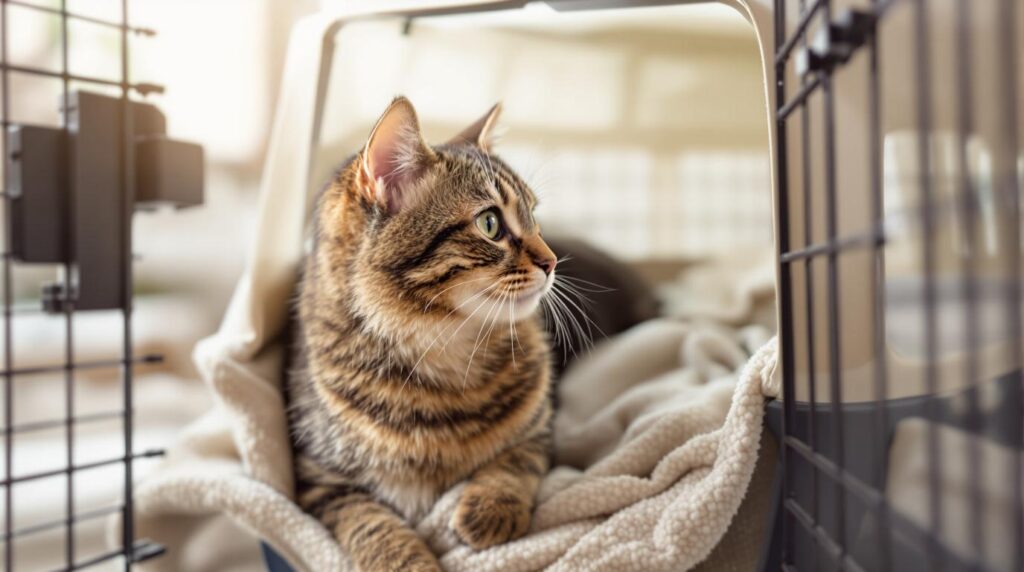
Moving is the highest-risk change, so it needs the most careful approach.
Before Moving Day
If possible, take your cat to the new home for a brief visit before the actual move. Let them explore for 10-15 minutes. This gives them a head start on scent mapping.
Bring familiar blankets and beds to the new home and place them in different rooms. Your cat’s scent on these items creates “anchor points.”
Set up a “safe room” in the new home before your cat arrives. A bathroom or spare bedroom works perfectly. This room should have:
- Litter box in one corner
- Food and water in the opposite corner (at least 8 feet away)
- Familiar bed or blankets
- A few favorite toys
Moving Day
Keep your cat confined during the actual move. Either keep them in a carrier or lock them in a small room in your old home while furniture is being moved.
Transport your cat to the new home AFTER the furniture is placed. Seeing furniture in familiar positions helps with the transition.
Important: Place your cat directly in the prepared safe room. Do NOT let them roam the entire house on day one.
Days 1-3: Safe Room Confinement
Your cat stays in the safe room for the first few days. Yes, this feels restrictive. But it’s crucial.
Why? Because your cat needs to establish one small area as “definitely safe” before tackling the whole house. Trying to mark an entire house at once is overwhelming.
Plug in a Feliway diffuser in the safe room before your cat arrives.
Spend 15-20 minutes in the safe room with your cat three times daily. Bring a book, work on your laptop, just be there calmly. Your presence helps them feel secure.
Days 4-7: Gradual Room Introduction
Open the safe room door. Let your cat explore at their own pace. Don’t force it.
Introduce ONE room at a time. Start with the room adjacent to the safe room.
Here’s a technique that works incredibly well: Take a soft cloth and rub it gently on your cat’s cheeks (where their scent glands are). Then dab that cloth on furniture in the new room. You’re manually spreading your cat’s scent, helping them mark the space faster.
Let your cat return to the safe room whenever they want. It remains their home base.
Week 2-4: Full House Integration
By week two, your cat should have access to all rooms.
Now place litter boxes and resources throughout the house—not just in the safe room anymore.
Maintain your cat’s exact routine. Same feeding times. Same play times. Same bedtime. Routine is your secret weapon during transitions.
Continue using Feliway diffusers in rooms where your cat seems most anxious or has sprayed.
Expected outcome: 60-80% of cats stop spraying by week 4 with this protocol.
PROTOCOL 2: Renovation/Remodeling

Renovations are tricky because you can’t move to a different house—you have to manage the cat IN the disrupted space.
Before Renovation Starts
Confine your cat to the un-renovated section of your home. If you’re renovating the kitchen, your cat lives upstairs or in the bedrooms during construction.
Set up complete resources in the safe zone—everything they need without accessing the construction area.
Buy air purifiers for the safe zone. Construction smells travel, and the less your cat smells paint and dust, the better.
During Renovation
Keep your cat strictly away from active construction. Use baby gates or closed doors.
Do not let your cat “supervise” the work. I know it’s tempting, but the noise, activity, and strange people increase stress dramatically.
Maintain routine in the safe zone as much as possible.
After Renovation Completes
This is where most people make mistakes. They assume since the work is done, the cat can immediately access the new space.
Not yet.
First, air out the renovated rooms for 24-48 hours with windows open. Those chemical smells need to dissipate.
Wipe down new surfaces with diluted vinegar (1 part vinegar to 3 parts water). This reduces lingering chemical odors.
Now manually spread your cat’s scent. Rub that soft cloth on your cat’s cheeks again, and dab it onto new cabinets, walls, and furniture. You’re giving your cat a scent head start.
Place familiar items in the renovated space—your cat’s favorite blanket, a well-used toy. These scent anchors help.
Introduce your cat to the renovated room gradually. Let them explore for 15 minutes supervised, then expand access over several days.
Expected outcome: Most cats adjust within 2-3 weeks if properly managed during and after construction.
PROTOCOL 3: New Baby Arrival
Baby arrivals are tough because you can’t exactly confine a baby to one room. The disruption is house-wide.
Before Baby Arrives
Set up the nursery 4-6 weeks in advance. Let your cat explore it under supervision. This removes the “suddenly everything changed” shock.
Play recordings of baby sounds—crying, cooing, babbling—starting at low volume and gradually increasing. This desensitizes your cat to the sounds.
Introduce baby smells early. Dab a tiny bit of baby lotion or powder on your own skin. Let your cat get used to the scent before it’s associated with a competing family member.
Establish “cat-only” spaces—rooms the baby won’t access initially. Your cat needs retreats.
When Baby Comes Home
Here’s a critical tip: Have your partner bring the baby inside while you greet your cat first. You maintain your bond; your cat doesn’t feel immediately displaced.
Let your cat sniff the baby from a distance (3-5 feet). Don’t force close interaction. Cats need to approach on their own terms.
The number one most important thing: Maintain your cat’s routine EXACTLY. Same feeding times. Same play times. Same person doing cat care when possible.
This cannot be overstated. Your cat can handle the baby’s presence if everything ELSE stays the same.
First Month
Never push your cat away to attend to the baby. This creates negative association. If your cat is on your lap and the baby cries, hand the baby to your partner if possible.
Reward calm behavior near the baby with treats.
Protect your cat’s resources from the baby’s reach as the baby becomes mobile.
Use Feliway diffusers in rooms where your cat spends the most time.
Give your cat extra attention during the baby’s naps. Even 10 minutes of dedicated play time helps tremendously.
Expected outcome: About 50% of cats adjust within 3-4 weeks. The other 50% need the full 2-3 months. Babies are a big adjustment.
PROTOCOL 4: New Partner/Roommate
A new person is easier to manage than a baby because they can actively participate in the cat’s adjustment.
Before Move-In
Have the new person visit multiple times before moving in—1-2 hour visits work well.
The new person should IGNORE the cat initially. Let the cat approach them, not the other way around. Cats respect people who respect their boundaries.
During visits, have the new person feed the cat or play with a wand toy. This builds positive associations.
Move-In Day
Introduce the new person’s belongings gradually. One room at a time, not everything at once.
Don’t immediately blend all possessions. Keep the cat’s areas distinct initially—your stuff in the bedroom, their stuff in the living room. Gradual integration over 2-3 weeks works better.
Maintain the cat’s routine. Same feeding times and locations.
First Week
The new person should actively participate in cat care—feeding, play, litter box cleaning if needed. This builds bonds.
Make sure the cat still has access to “original owner only” spaces. Maybe the bedroom stays primarily yours and the cat’s for the first month.
The new person shouldn’t immediately claim the cat’s favorite spots. If the cat loves the left side of the couch, leave that spot available for a few weeks.
Week 2-4
Gradually blend spaces and routines.
Put the new person’s scent on the cat’s items—rub their worn shirt on the cat’s bed. This mingles scents.
Do activities together with the cat—both people playing with the cat simultaneously.
Expected outcome: Most cats adjust within 4-6 weeks if the new person respects boundaries and builds positive associations.
Prevention Strategies: Stop Spraying Before It Starts

What if you could prevent spraying from ever starting? Here’s how.
Pre-Change Preparation Checklist
Maintain rock-solid routine 2 weeks before changes.
Feed at exactly the same times. Play at the same times. Keep sleep schedules consistent. Cats crave predictability—give them extra stability before you disrupt their world.
Increase pheromone use proactively.
Plug in Feliway diffusers a week before your move or renovation. This creates a calmer baseline so your cat isn’t starting from maximum stress.
Create a “safe haven” room.
Designate one room that will NOT change. A guest room or office works perfectly. No matter what else happens, your cat knows this one space will stay familiar.
Introduce new scents gradually when possible.
Buying new furniture? Rub your cat’s blanket on it before bringing it inside. New partner moving in? Have them wear the same cologne during visits that they’ll use after moving in. These gradual scent introductions reduce shock.
During Changes: Minimizing Impact
Confine, don’t isolate.
Keep your cat in a safe space during active changes, but visit frequently. The difference between confinement (safe, you’re nearby) and isolation (scary, abandoned) is huge.
Maintain “normalcy anchors.”
Keep your cat’s food bowls in the same location if at all possible. Use the same litter type. Stick to exact feeding times even if everything else is chaotic. These anchors provide stability in the storm.
Slow down the change pace when possible.
Replace furniture one room at a time, not the whole house at once. Renovate one space, let your cat adjust, then move to the next. The slower you go, the easier the adjustment.
These strategies reduce spraying risk by 40-50%. Prevention is always easier than fixing a problem after it starts.
Troubleshooting: When Spraying Continues After Changes

Sometimes spraying doesn’t resolve on the expected timeline. Here’s what to do.
Problem 1: It’s Been 8+ Weeks, Cat Still Sprays Daily
What’s happening:
The spraying has likely become habitual, no longer purely related to the change. It’s now an entrenched behavior pattern.
Solution:
Reassess everything. Are there ongoing stressors beyond the initial change? New outdoor cats? Conflict with another household cat?
Change your approach. Stop treating this as acute adjustment spraying. Treat it as chronic spraying requiring deeper intervention.
Consider consulting a veterinary behaviorist. They can assess whether anxiety medication might help break the habit (typically 2-3 months of medication while you work on behavior modification).
Problem 2: Spraying Stopped, Then Restarted
What’s happening:
Either a secondary trigger appeared, or your cat’s scent establishment was incomplete.
Investigate:
Did something ELSE change recently? Did outdoor cats appear near your windows? Did you switch food brands or litter types? Small changes can restart spraying in cats who were barely stable.
Is your cat spraying the same locations as originally, or new spots? This tells you a lot.
Solution:
If same locations: The scent markers are fading. Manually reapply your cat’s facial pheromones (cheek-rubbed cloth technique) to those areas.
If new locations: There’s a new trigger. Identify and address it.
Problem 3: Multiple Changes Happened at Once
What’s happening:
Compound stress. Maybe you moved AND got a new partner. Or renovated AND had a baby. Multiple major changes create severe territorial insecurity.
Solution:
Prioritize stability in whatever remains unchanged. If you can’t control the changes, double down on routine, resources, and safe spaces.
Expect a longer adjustment period—3-4 months instead of 1-2.
Seek professional help earlier. Don’t wait the full 8 weeks if multiple changes occurred. Call a behaviorist at week 4-5.
Consider medication more seriously. Compound stress may require pharmaceutical support.
Problem 4: Cat Only Sprays in the Changed Areas
What’s happening:
Your cat has developed a specific aversion to the altered spaces.
Solution:
Keep your cat away from those areas longer—2-3 weeks instead of 1.
Heavily apply your cat’s scent manually before reintroducing them.
Place their absolute favorite items in the changed spaces—the bed they love most, their favorite toy.
If aversion persists, you may need to block access permanently. Some cats never accept certain changed spaces.
Real Success Stories: Cats Who Stopped Spraying After Changes

Let me share three real examples to give you hope.
Case Study 1: The Cross-Country Move
Tom moved from California to New York with his two cats, Milo and Luna. Both started spraying within 48 hours of arriving at the new apartment. Milo sprayed the bedroom. Luna sprayed the living room walls.
Tom followed the moving protocol:
- Week 1: Kept both cats in the bathroom with all their resources
- Week 2: Introduced the bedroom only
- Week 3: Full apartment access
- Used Feliway diffusers in every room
Milo stopped spraying by week 3. Luna took until week 5, but eventually stopped completely. Six months later, no spraying at all.
Tom’s reflection: “The safe room confinement felt cruel at first—keeping them in the bathroom seemed mean. But looking back, it gave them a secure base to build confidence from. If I’d just let them loose in the whole apartment on day one, the spraying would’ve been way worse.”
Case Study 2: The Kitchen Renovation
Maria renovated her kitchen over six weeks. Her cat Oliver started spraying the kitchen doorway and adjacent dining room.
Maria’s protocol:
- Kept Oliver in upstairs bedrooms during all construction
- Aired out the kitchen for three full days after completion
- Manually spread Oliver’s scent on new cabinets using the cheek-rubbed cloth technique
- Gradually reintroduced Oliver to the kitchen—fed him near the kitchen entrance first, slowly moved his food bowl inside over a week
Oliver stopped spraying within two weeks of the renovation being complete.
Maria’s lesson: “I didn’t realize the paint smell was the real trigger. Once I aired it out properly and helped him ‘re-mark’ the space with his own facial scent, he calmed down almost immediately. The smell was the problem, not the visual changes.”
Case Study 3: The New Baby
Rachel’s cat Sophie started spraying the nursery and master bedroom after baby Emma arrived.
Rachel’s approach:
- Maintained Sophie’s exact feeding schedule despite baby chaos
- Her partner took over Sophie’s care when Rachel was nursing
- Used a baby gate so Sophie could observe Emma from a distance without forced interaction
- Dedicated 15-minute play session with Sophie during Emma’s first nap every day
Sophie’s spraying reduced by 70% within four weeks. By month three, it stopped completely.
Rachel’s key insight: “The game-changer was the dedicated attention. Once Sophie realized Emma didn’t mean total abandonment, she relaxed. But I had to PROVE that with my actions, not just hope she’d figure it out.”
Conclusion: Your Cat CAN Adjust to Changes
Let’s bring this all together.
Your cat is spraying after home changes because those changes erased their familiar scent markers. They’re not being difficult or spiteful—they’re experiencing genuine territorial insecurity. Their survival instinct is screaming “Mark the territory NOW!”
The good news? Most change-related spraying is temporary. With the right protocol for your specific change type—moving, renovation, new baby, new person—60-80% of cats stop spraying within 4-6 weeks.
Your action steps:
- Identify your change type. Was it moving? Renovation? New family member? Each needs a slightly different approach.
- Follow the specific protocol. Don’t wing it. The protocols in this guide are proven to work.
- Track progress weekly. Expect gradual improvement, not overnight miracles. Look for the week-by-week signs we discussed.
- If there’s no improvement by week 8, troubleshoot or seek professional help. Don’t keep doing the same thing if it’s not working.
Your cat isn’t being difficult. They’re genuinely stressed and trying to cope the only way they know how. Your patience, understanding, and the right strategy will help them feel secure again.
Imagine your life returning to normal. No more discovering spray spots. No more constant cleaning. Just your cat, settled and happy in your changed home.
It’s possible. Most cats get there within a few weeks with the right approach.
Start with your specific protocol today. The sooner you help your cat re-establish their sense of territory security, the sooner the spraying stops.
You’ve got this. And so does your cat.


